~850 CE
The Legend of Kaldi
According to Ethiopian legend, a young goatherder named Kaldi noticed his goats dancing with unusual energy after eating bright red berries from a shrub. He tried them himself and felt remarkably alert.
Kaldi shared his discovery with a local monastery, where the monks initially dismissed the berries. That night, the head monk tried them and found himself awake through evening prayers. The monastery began cultivating what they called "qahwa" — the beverage that banishes sleep.
While the legend may be embellished, botanical evidence suggests coffee cultivation began in Ethiopia's southwestern highlands between the 6th-9th centuries.

1000-1450
Crossing to Yemen
Coffee cultivation crossed the Red Sea to Yemen, where it thrived. The ancient port of Al-Mukha (anglicized as "Mocha") gave its name to the coffee variety that would become world-famous.
Yemeni Sufi monasteries embraced coffee for nighttime devotions. The drink spread throughout the Islamic world, though not without controversy — some religious authorities initially banned it.
The Yemenis fiercely guarded their monopoly for over 300 years, exporting only boiled or roasted beans to prevent germination. Smuggling fertile seeds was punishable by death.

1517-1600
The Ottoman Coffee Houses
When Ottoman Sultan Selim I conquered Egypt in 1517, coffee came to Constantinople. Syrian merchants opened the first Ottoman coffeehouses — "kahvehane" — which became known as "schools of the wise."
Men gathered to drink coffee while discussing politics, literature, and philosophy. The Sultan briefly banned them for being socially disruptive.
Pope Clement VIII famously declared coffee "so delicious it would be a pity to let the infidels have exclusive use of it." With papal blessing, coffee spread through Catholic Europe.

1650-1750
The Penny Universities
England's first coffee house opened in Oxford in 1650. These "penny universities" charged one penny for admission and coffee — gathering places for merchants, writers, and revolutionaries.
In 1688, Edward Lloyd opened a coffee house where merchants gathered to share shipping news. It became Lloyd's of London, the world's leading insurance market.
The Boston Tea Party (1773) made tea unpatriotic. Americans embraced coffee as the revolutionary beverage. Meanwhile, Parisian coffee houses hosted Voltaire, Rousseau, and Diderot.

1727-1800
Breaking the Monopoly
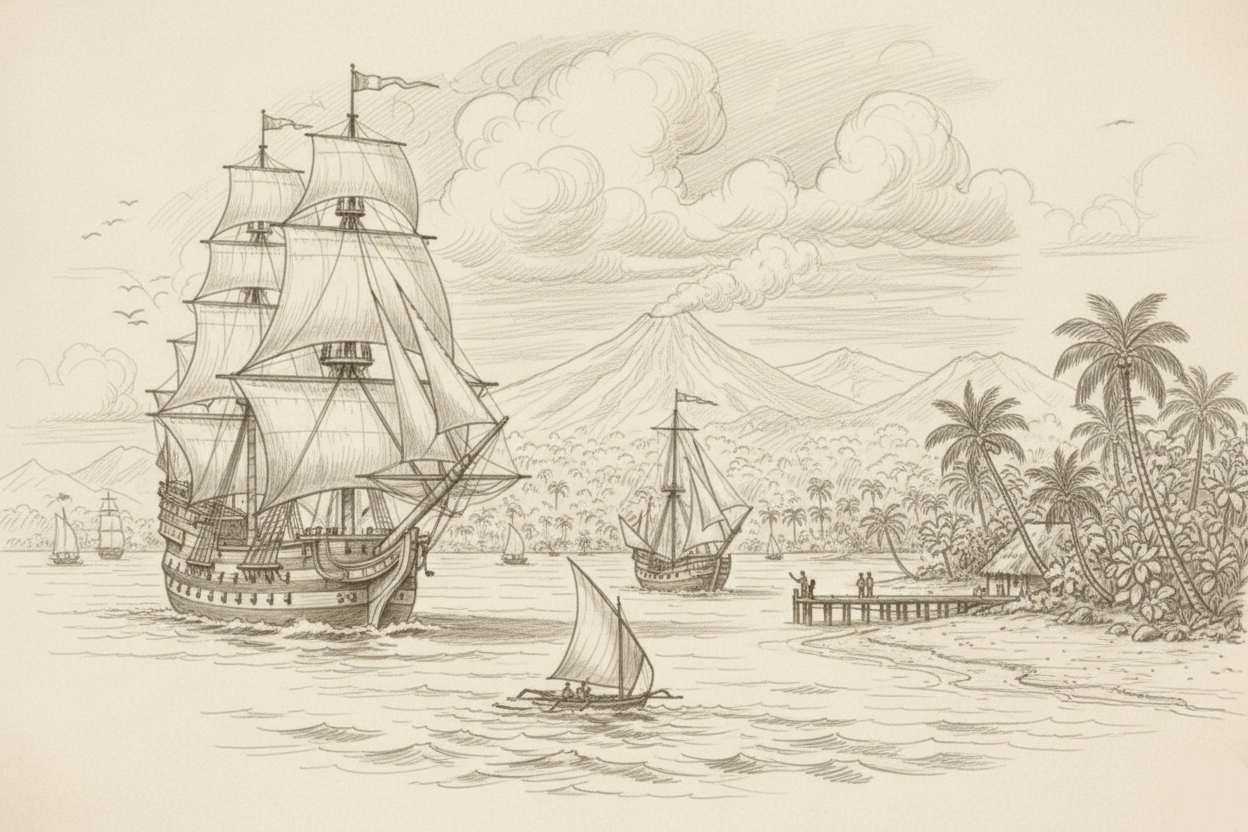
Dutch traders broke Yemen's monopoly by smuggling fertile beans to Java in 1699. Within decades, the Dutch East India Company exported more coffee than Yemen.
In 1723, French officer Gabriel de Clieu brought one coffee plant from Paris to Martinique. That single shrub became ancestor to all Caribbean, Central and South American coffee.
Portuguese colonists established Brazilian coffee in 1727. By 1800, colonial cultivation had spread globally.
1800-1900
The Industrial Era
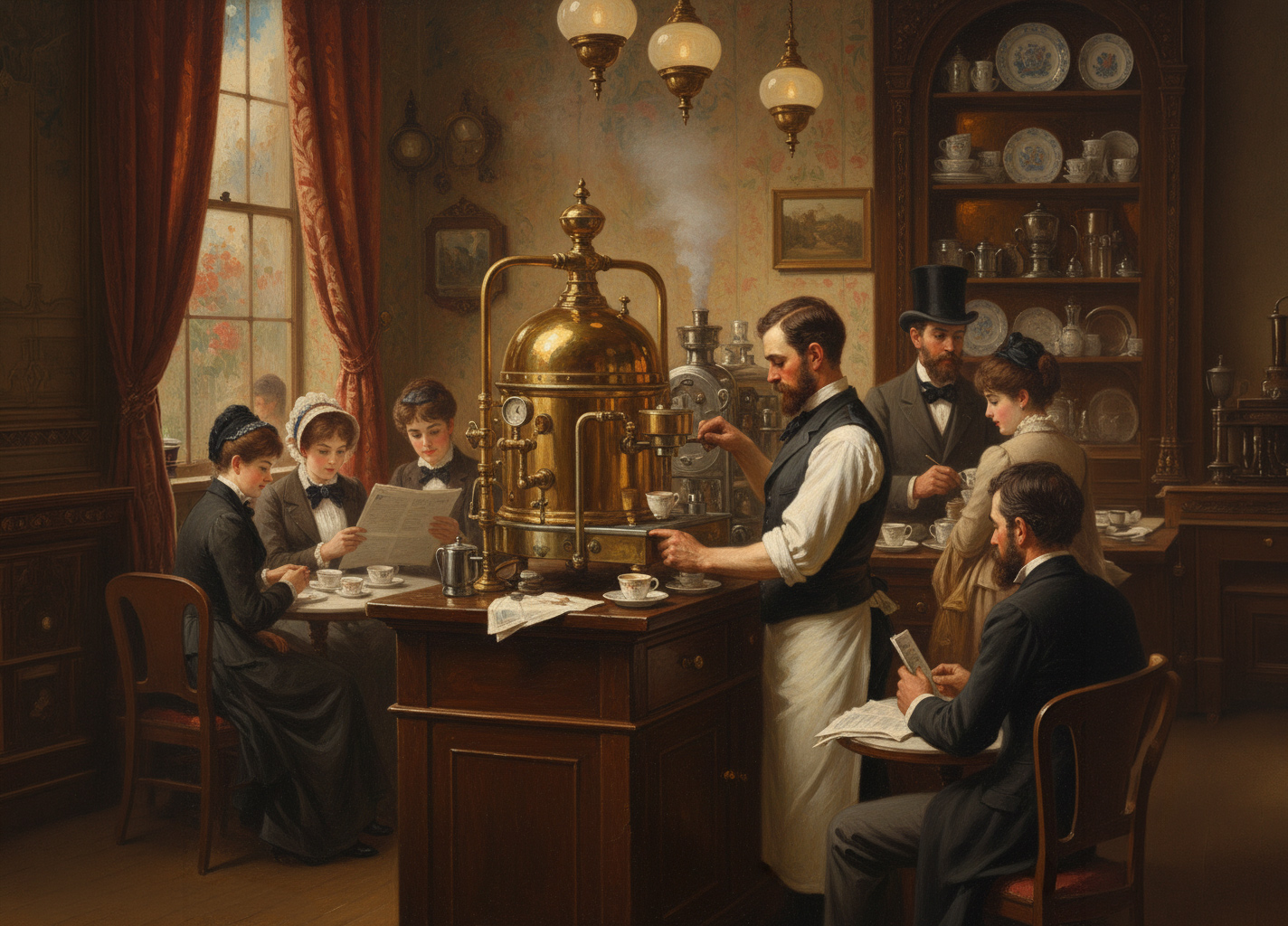
In 1822, the first Espresso machine debuted at the Paris Exposition. In 1890, David Strand invented instant coffee in New Zealand. Coffee became truly global.
Brazil emerged as dominant producer after the 1822 independence, eventually controlling 80% of world production. The "Coffee Barons" shaped Brazilian politics and economy.
By 1900, coffee was the world's second-most traded commodity (after oil), supporting millions of livelihoods.
1900-Present
Modern Coffee Culture
The 20th century brought mass marketing, instant coffee, and diner culture. Post-WWII, specialty coffee began emerging in places like Peet's (1966) and Starbucks (1971).
The "Third Wave" movement of the 2000s emphasizes single-origin beans, artisanal roasting, and treating coffee like wine — complex, terroir-driven, crafted.
Today, coffee generates over $200 billion annually. Over 2.25 billion cups are consumed daily worldwide. It remains the world's second-most traded commodity, supporting 125+ million people's livelihoods across 70+ producing countries.